
Could You Reconstruct This Interview Six Months From Now?
An analyst wants to speak with a former operator. The topic is relevant. The deadline is tomorrow.
Before that conversation happens, your team needs to understand who is participating, what they can discuss and which restrictions apply. Afterward, you may need to review what was said and determine what can reach the investment team.
Months later, someone may ask how the interview was handled.
How much work would it take to answer?
01What exactly did you approve
A relevant background is the beginning of the review.
Employment dates, relationships with the companies being discussed and the proposed scope all help establish whether a conversation should proceed. Your firm may impose restrictions beyond a provider’s standard process.
Those requirements need to follow the project. A condition recorded in an email is useful only if the people conducting and reviewing the interview know it applies.
Could someone reviewing the research later understand the conditions under which it was approved?
02What happens after the interview begins
Screening and training establish expectations. The conversation still needs attention.
An expert may move beyond the intended topic. A response may require clarification. Something may need to be escalated for review before the investment team receives the research.
These situations deserve a defined process: who reviews the material, who decides what happens next and how that decision is recorded.
Adding interview capacity makes that process more important. Oversight needs to be designed into the workflow as the volume grows.
03Can you get back to what was actually said
A summary helps a reader navigate an interview. A reviewer may need the underlying exchange.
What question prompted the response? Did the expert describe firsthand experience or offer an opinion? Was a statement qualified elsewhere in the conversation?
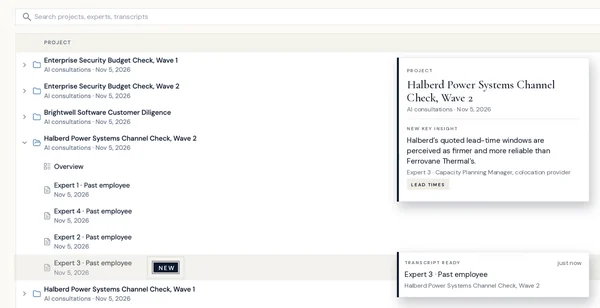
Recordings and transcripts give reviewers material to examine in context. Keeping them connected to the relevant project and review history makes it easier to understand how the research was handled.
The practical test is straightforward: can your team retrieve the interview and the decisions surrounding it without reconstructing the process from separate inboxes?
04Where does the research go next
The workflow continues when the interview ends.
Research may enter a shared library, appear in a report or become accessible through an internal AI tool. That raises another set of questions about who can access the material and which restrictions continue to apply.
When evaluating a new research workflow, follow the information through its full journey. Ask how approval, review, release and later access fit together.
Your controls should remain meaningful wherever the research is used.
A research workflow your team can inspect
Seersite’s approach combines expert identity verification, conflict checks and training with client-specific controls. Its Compliance Portal supports client review and approval, alongside research history and usage reporting.
Recordings and transcripts give your team underlying material to examine. The objective is to make the research process easier to review, with clear points for your firm’s requirements to apply.
Before your team commissions its next project, ask what you would need to see if someone returned to it six months from now.