
Your Research Invoice Doesn’t Show the Full Cost.
The invoice tells you what you paid for the interview.
It rarely tells you how much work it took to get a useful answer. Or how much of a prepaid commitment went unused. Or which questions your team stopped pursuing because getting another perspective felt like too much effort.
If you oversee the research budget, those costs deserve a place in the conversation.
What are you actually getting for the money your firm spends?
01Are you buying around your questions
A prepaid agreement can make sense when usage matches the commitment. But research demand changes.
A position closes. A sector becomes less relevant. The team needs a different kind of expertise. Credits remain, so the next purchasing decision starts with the balance already on the account.
That can make it harder to evaluate a new approach, even when it addresses a useful gap.
When reviewing a research agreement, look at how well its structure fits the work your team expects to do. Include what happens when those expectations change.
02Where does the internal work sit
The provider’s fee is one part of the process.
Someone still has to explain the project, assess relevance, coordinate participants, process the findings and decide whether the original question was answered. A low interview price can coexist with substantial internal effort.
Map a recent project from the initial request to the final findings. Where did it stall? Where did your team repeat information? Which steps required investment judgment, and which could have been handled elsewhere?
That is where a more useful operating comparison begins.
03What counts as useful output
Interview volume is easy to count. Useful research requires closer examination.
Did the participants have experience relevant to the question? Did the interviews explore different perspectives? Could the team identify what remained uncertain and commission a focused follow-up?
Several interviews that repeat the same broad observations may contribute less than a smaller project designed around a specific gap.
Evaluate a provider on the work your team can do with the findings. Include relevance, depth, delivery and the effort required to assess the evidence.
04Can you evaluate a new approach in a contained way
Changing a research workflow does not require moving every project at once.
Choose a question with a clear scope. Agree on the relevant expert backgrounds, the deliverables and the criteria your team will use to assess the result. Set the budget before the work begins.
Afterward, review the full process. What did the team learn? How much internal coordination was required? Where did a live discussion remain valuable?
A focused evaluation gives you a concrete basis for deciding which types of research belong in which workflow.
Make the economics visible
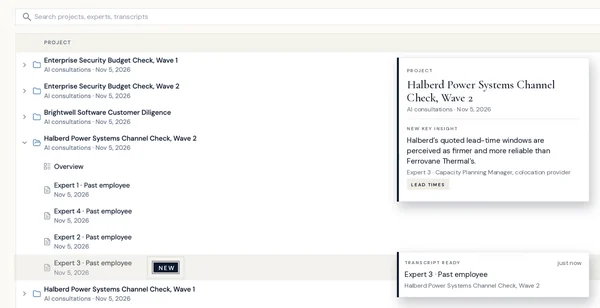
Seersite helps teams commission Primary Research through AI-moderated interviews and live calls. AI interviews run without an analyst attending, with recordings, transcripts and findings available for the team to review.
The research accumulates in a private Vault that the team can search and revisit. That gives you another dimension to evaluate: how readily completed work can contribute to a later project.
When you review your next research purchase, look beyond the interview price. Consider the commitment, the internal work and the usefulness of what comes back.